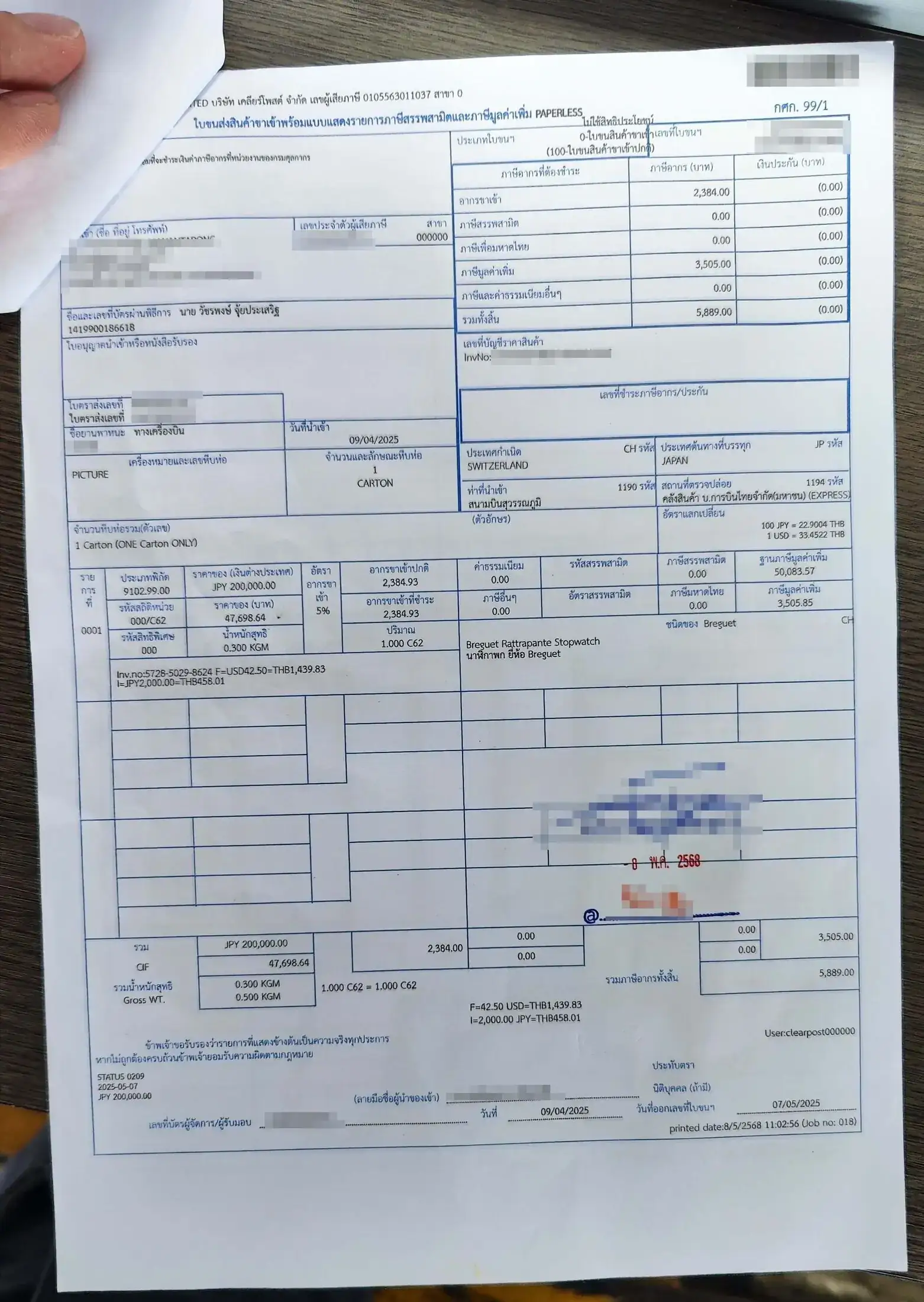
Thailand Customs Valuation Explained — How Duties & Taxes Are Actually Calculated

For many foreign businesses importing to Thailand, one of the most confusing parts of the process is customs valuation—how Thai Customs calculates duties, VAT, and any other taxes you need to pay.
Understanding this is essential for budgeting, preventing unexpected costs, and avoiding delays at the port.
This guide breaks down the valuation process in a simple, practical way so you always know what to expect when importing goods to Thailand.
**Why Customs Valuation Matters**
Accurate valuation affects:
- Import duty
- VAT (7%)
- Excise tax (certain products only)
- Customs clearance speed
- Risk of inspection or revaluation
- Your final landed cost
If your declared value seems too low or inconsistent with your documents, Thai customs may review or revalue it—leading to delays or additional charges.
**1. Thailand Uses the CIF System**
Thailand calculates duties using the CIF value, which means:
CIF = Cost + Insurance + Freight
These three elements form the base value for calculating duties and taxes.
**Cost (C)**
The actual price you paid for the goods.
MUST match the commercial invoice.
**Insurance (I)**
Insurance cost for the shipment. If not provided, customs may assign a standard percentage.
**Freight (F)**
Shipping cost to Thailand.
If freight is missing, customs may estimate it based on common rates.
**2. How Import Duty Is Calculated in Thailand**
Once the CIF value is confirmed, import duty is applied according to your HS code.
Example:
- CIF value: 100,000 THB
- Import duty rate: 10%
Duty = 100,000 × 10% = 10,000 THB
Correct HS classification is essential because the duty rate can range from 0% to 80%, depending on the product.
**3. VAT Calculation (7%)**
VAT is calculated after adding CIF + duty.
Using the previous example:
- CIF: 100,000 THB
- Duty: 10,000 THB
VAT = (CIF + Duty) × 7%
VAT = 110,000 × 7% = 7,700 THB
**4. Additional Taxes That May Apply**
Not all products have extra taxes, but some categories do.
**Excise Tax**
Applies to items such as:
- Alcohol
- Tobacco
- Energy drinks
- Cosmetics
- Vehicles
- Certain electronics
Excise tax has its own calculation formula depending on the product type.
**Interior Tax (Local Tax)**
Only for products subject to excise tax.
Usually calculated as:
Interior Tax = Excise Tax × 10%
**Customs Surcharge**
Applied if there is:
- Under-declaration
- Late duty payment
- Incorrect HS code classification that leads to higher payable duties
**5. Why Customs Revalue Shipments**
Thai Customs may question your declared value if:
- The price is much lower than market value
- The seller is related to the buyer
- HS code seems incorrect
- Previous similar shipments had higher declared values
- Documents show inconsistent values (invoice vs. contract vs. packing list)
- Freight or insurance is missing
- Product description is unclear
In these situations, customs uses the WTO Valuation Agreement to reassess the value.
Revaluation always causes delays, so clear documents help avoid it.
**6. How to Prevent Valuation Problems**
✔ **Use clear, detailed invoices**
Include product description, model number, specifications, and unit price.
✔ **Match all documents**
Invoice, packing list, purchase order, BL/AWB — values must be consistent.
✔ **Provide freight and insurance**
Missing numbers create delays.
✔ **Use realistic market pricing**
Declaring unrealistically low prices raises red flags.
✔ **Choose the correct HS code**
Wrong codes lead to wrong duty rates → customs checks.
✔ **Work with a licensed Thai customs broker**
They know how customs evaluates pricing and documents, reducing risk.
**7. Example: Full Thai Customs Calculation (Simplified)**
Let’s say you import electronic accessories:
- Product cost: 80,000 THB
- Freight: 10,000 THB
- Insurance: 1,000 THB
- Duty rate: 5%
Step 1: CIF
CIF = 80,000 + 10,000 + 1,000 = 91,000 THB
Step 2: Duty
Duty = 91,000 × 5% = 4,550 THB
Step 3: VAT
VAT = (CIF + Duty) × 7% = 95,550 × 7% = 6,688.5 THB
**Total Taxes = Duty + VAT = 11,238.5 THB**
This is your landed cost before warehousing and delivery.
**Conclusion**
Understanding how Thailand calculates customs duties and taxes gives your business a huge advantage. Whether you're importing food, electronics, machinery, or consumer goods, knowing how valuation works helps you:
- Predict costs accurately
- Avoid customs delays
- Prevent revaluation or penalties
- Improve your supply chain efficiency
If you need help with customs valuation, HS classification, or full import management, a professional Thai customs broker can make the process faster, clearer, and much easier.